
They’re All Connected
You’ve probably heard the lyrics from the song “Dem Bones”: Toe bone connected to the foot bone, foot bone connected to the ankle bone, ankle bone connected to the leg bone…. All the bones and joints in the lower body work together as a ‘closed kinetic chain’, meaning when one changes, it impacts the activity of all the rest; they’re all connected. As those changes affect the pelvis, that in turn affects the entire spine, neck and head. Those abnormalities lead to subluxation and results in uncoordinated nerve system response.
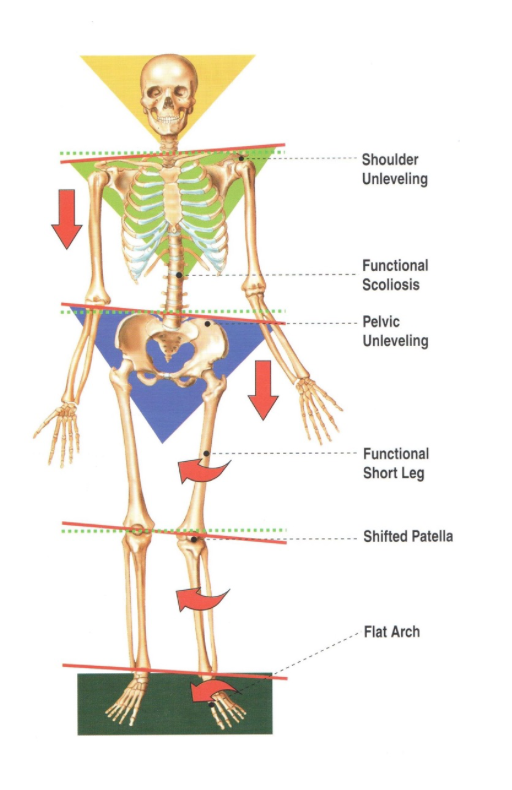
they’re all connected
Coordination is Essential
As we walk, there is highly specialized coordination between the movements of our lower extremities and the balancing of our spine. Normal walking causes predictable, repetitive motions to occur from our feet all the way to our head. The accurate timing of the many muscle contractions required during walking and running depends on nerve signals from a symmetrical gait. Recent research in several fields has contributed to our appreciation of this complexity.
We now understand that excessive foot pronation (flattening or weakness of foot arch), whether in one foot or both, interferes with these carefully orchestrated movements, and causes problems throughout the musculoskeletal system. The effects of excessive pronation on the function of the spine are of particular interest.
Foundational Feet
When foot pronation occurs while standing, there is normal inward rotation of the entire leg and pelvis. In people who have excessive or prolonged pronation (during gait), this twisting movement is accentuated. The increased rotational forces are transmitted into the pelvis, and especially the sacroiliac (SI) joint. In response, various pelvic subluxation complexes develop in an attempt to compensate for abnormal foot structure and movement. These include pelvic tilts, rotation movements and other complicated adaptations. Some people benefit from custom foot orthotics to stabilize their foot structure and the results are a more stable pelvis, lower back and entire spine.
Stability = Resistance to Stress
Stability of the spine and pelvis means healthier joints, discs, bones and nerves. Resistance to physical, chemical and mental stress increases. It also means, for many people, that they will hold adjustments longer. If you want to have your feet checked, let us know and we can refer you to a chiropodist for a thorough assessment. Your feet (& pelvis & spine & neck & head & nerves) will thank you!


